
Printing for Welsh charities and community groups
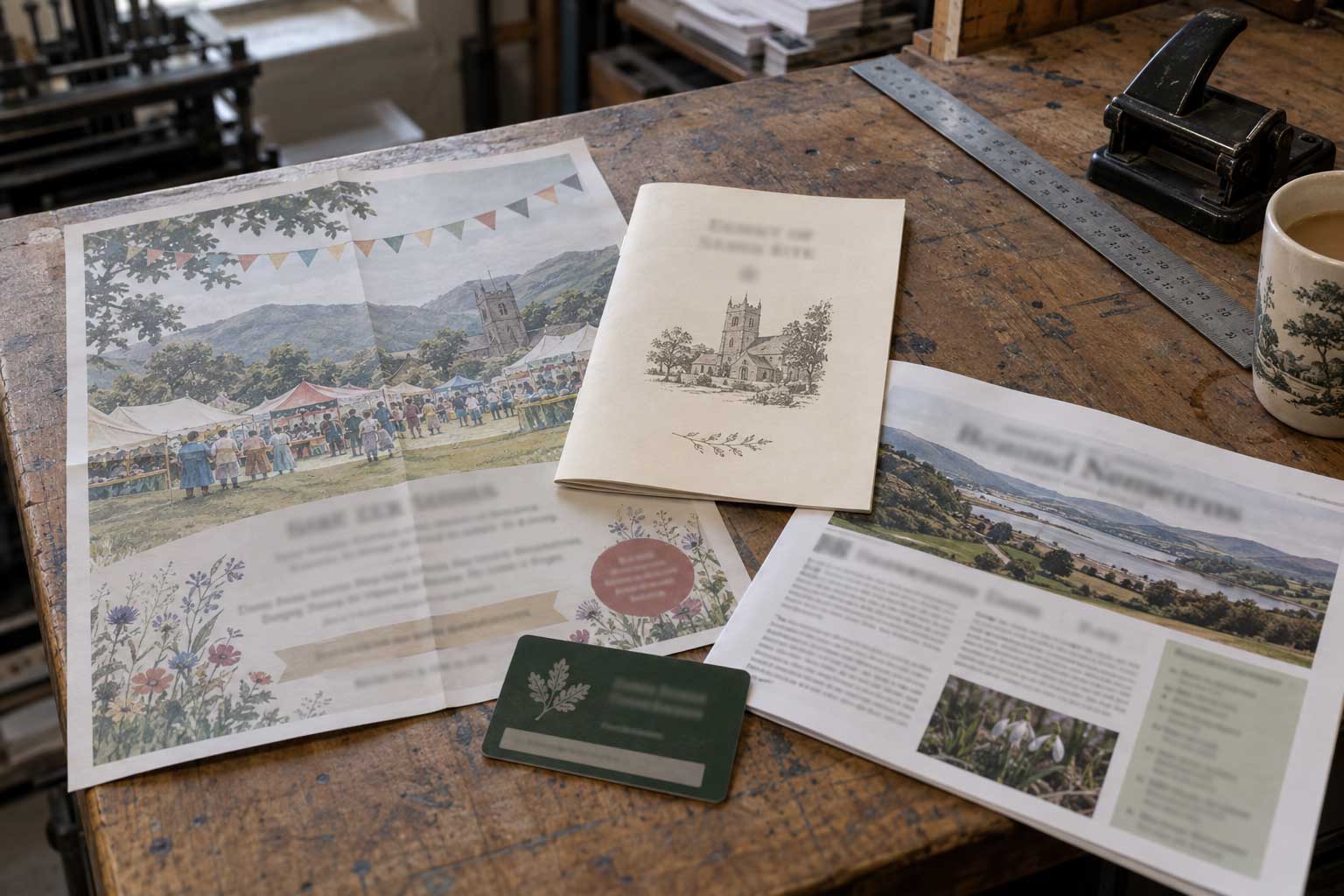
Community groups and small charities across North Wales run on quiet hard work, thin budgets, and a lot of volunteer time. Their printing needs are real (posters for a fundraiser, order of service for a chapel, membership cards for a sailing club, an appeal letter to members) but their budgets rarely stretch to what a commercial marketing team would spend on the same job.
We work with a lot of these organisations at our works in Llangefni. Chapels, sports clubs, agricultural societies, community councils, hospice charities, sailing clubs, choirs, schools, food banks, and youth groups. What follows is what we tell coordinators and secretaries when they're planning a print run and want it done well without spending more than they need to.
What we most often print for community groups and charities
Every group is different, but the repeat items are usually one of these:
- Event posters and leaflets. Coffee mornings, fundraisers, jumble sales, choir concerts, agricultural shows. Usually A4 or A5, colour, run sizes of a few hundred.
- Membership cards and receipts. Small print jobs that need to look tidy. Usually credit-card size, printed on 350gsm silk.
- Order of service booklets. For chapel services, memorial services, and choir performances. Typically an A5 folded card or a small stapled booklet.
- Appeal letters and newsletters. A folded A4 to a few hundred members, sometimes with a reply slip. The workhorse of charity communications, and still one of the most effective ways to raise money.
- Roll-up banners for stands. The pull-up displays for stalls at agricultural shows, indoor fetes, and community events.
- Thank-you cards and printed correspondence. For donors, volunteers, and members. A well-made thank-you card is often the single best fundraising asset a small charity has.
Digital: right for almost every community print job
Most community and charity print runs are between 50 and 500 copies. That's firmly digital press territory. Colour is excellent, turnaround is 24 to 48 hours from artwork sign-off, and there's no plate setup cost to spread across a large run.
We'd only move a community job to litho if the run size exceeded a few thousand copies (a large membership newsletter for a regional charity, for example) or if brand colour precision was critical enough to justify Pantone matching. For the day-to-day work of most groups, digital is the honest answer.
Because there's no setup cost, digital also makes multiple small print runs affordable across the year. A group can print 200 event posters in March, 100 order of service booklets in July, and 500 appeal letters in November, without any of them costing more per copy than one big combined run would.
Welsh, English, and bilingual as standard
An unusually large share of the print we produce for community groups on Anglesey and across North Wales is bilingual, or Welsh-first. Chapel services, community council notices, school communications, and cultural events all naturally sit in Welsh, or in both languages side by side.
We know the conventions. Welsh place-name spellings, formal and informal registers, soft mutations, capitalisation. If your group is Welsh-speaking or bilingual, we'll work with you in whichever language you prefer, and we won't stumble over it. If you're English-only, we won't push the Welsh, it isn't decorative for us and it shouldn't be for you either.
Getting more from a limited budget
The single most useful piece of advice we give charity and community group coordinators is this: design once, print several times.
An event poster template with the event name, image, and colour scheme fixed, and only the date and venue changed each year, costs almost nothing to reprint annually. A newsletter with a house style and a folded format holds its shape across every issue, so each new one is a text update, not a design job. A roll-up banner without a year on it will happily do five years of events.
Other budget-conscious choices we'd flag at the quote stage:
- Standard sizes. A4, A5, DL, credit-card size. These print more efficiently than custom sizes and cost less.
- Silk-coated stock over uncoated. Usually cheaper and prints colour more brightly, which matters for event posters that need to catch the eye at a village hall notice board.
- One-sided over two-sided where the second side isn't earning its keep.
- Standard finishes over specialty. Straight guillotining and folding cost nothing extra. Specialty finishes are lovely, but rarely justify the cost for a fundraiser leaflet at 300 copies.
None of these choices make the finished piece look budget. Done well, they read as considered and professional, which is often what a small charity needs most from its print.
Working with volunteers, not designers
A lot of community group print starts life as a Microsoft Word document made by a volunteer who is otherwise excellent at running the group but has never professionally designed anything. We're used to this.
What we ask is that the file is legible, the details are correct, and the images (if any) are as high a resolution as you've got. From there, our design team can rework what you've sent into a print-ready format at modest cost, or we'll work with your Word file directly if it's genuinely ready to print. We'll always flag anything that's going to cause problems on the press before we run the job, which is when it's cheap to fix.
If your group has someone with design skills using proper software (Canva Pro, Affinity, Adobe), even better. We'll accept print-ready PDFs and treat them the same way we treat any professional file.
Lead times and pricing
For most community group print, we quote quickly, print quickly, and try to keep pricing straightforward. A typical event poster or newsletter is a 3 to 5 working day job from artwork sign-off. Order of service booklets and last-minute reprints are often faster.
We don't run a separate charity price list, but we do keep our pricing honest for the small orders that make up most of this work. If a job could reasonably be done at a lower spec without hurting the outcome, we'll say so at the quote stage.
Common questions
Do you offer a charity discount?
We don't run a formal charity discount, but our pricing on small runs is competitive, and we'll always suggest specs that keep the cost sensible without hurting the finished piece. For long-standing charity customers, particularly local ones, we've been known to make things work when a print run is important and the budget is tight.
Can we send you a Word document to print from?
Yes. Word files aren't ideal for print, but if the content is right and the images are sharp, we can work with one and produce a good result. Where the file needs reformatting, our design team can rework it into a print-ready PDF at modest cost. Either way, we'll flag anything that's going to cause a problem before we print.
Can you print in Welsh?
Yes. Welsh, English, or bilingual formats are routine for us. We know the conventions, from soft mutations to Anglesey place-name spellings, and print Welsh-language material for chapels, community councils, schools, and cultural groups on a regular basis.
What's the smallest quantity you'll print?
There's no set minimum. In practice, most small print jobs are 50 copies or more. Below that, the setup cost dominates, and we might suggest either bumping the quantity slightly or accepting a higher per-copy price. Either way we'll be transparent about the trade-off.
How quickly can you turn a print run around?
Most community group print is a 3 to 5 working day job from artwork sign-off. Urgent jobs (an event this weekend, a memorial service on Friday) are often faster. Tell us the deadline and we'll be honest about whether it's realistic.
Planning a print run for your group?
If your community group, charity, or membership organisation has a print job coming up and you'd like to talk it through, please get in touch. We'll quote honestly, suggest the spec that fits your budget and your outcome, and treat the work with the same care as our larger corporate jobs.
There's a full list of what we do under one roof, from leaflets and posters to order of service, membership cards, roll-up banners, and everything else.