
Large-format printing for outdoor events: what to know before you order
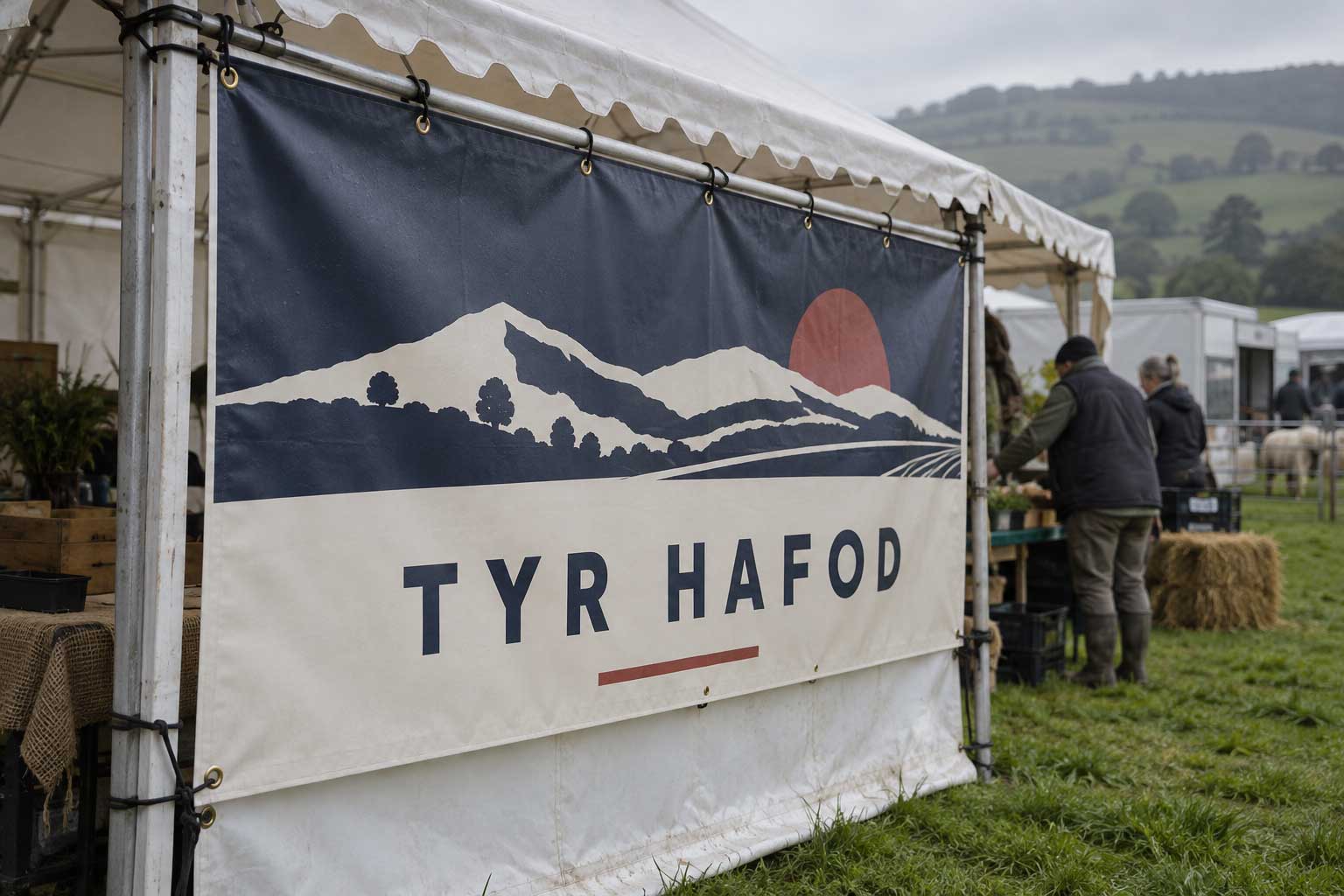
An outdoor event, especially a summer one on the North Wales coast, puts print through more than most posters ever encounter indoors. Wind, rain, salt, sun, and the occasional curious sheep. If the design won't survive the day, it doesn't matter how nice it looked in the office.
We print for a lot of outdoor events at our works in Llangefni. Agricultural shows, food festivals, sailing regattas, sports days, town-centre events, community fetes, wedding marquees. What we've learned is that most of the choices happen a couple of weeks before the event, and the ones that matter aren't always the obvious ones. Here's what we'd think through with you at the quote stage.
What we most often print for outdoor events
Every event is different, but the printed pieces tend to be the same five or six things:
- PVC banners. The workhorse of outdoor print. A vinyl-coated fabric on a durable backing, weather-resistant, eyeleted at the corners so they can be tied to fencing, marquees, gazebos, or trailers. Sizes from a few square feet up to the length of a stand.
- Roller banners. The pull-up displays that sit inside a marquee or trade stand. Not for outdoor exposure directly (they aren't designed to face weather), but they're the readable, stand-alone piece inside a covered space.
- Correx signs. Fluted plastic board, lightweight, rigid, waterproof. Fixed to fence posts, hedges, gate frames with cable ties. Cheap enough to leave in place across the run-up to an event and after.
- Foam board signs. Lightweight rigid boards, printed both sides, ideal for indoor or covered directions and menus. Not weatherproof, but excellent under a canopy.
- Vinyl decals. Adhesive-backed vinyl for vehicles, glass panels, or event trailers. Removable in most cases, permanent if specified.
- Feather flags. The tall printed flags on flexible poles, high-visibility from a distance and easy to plant in soft ground. Popular at outdoor fairs and roadside events.
Most events use two or three of these together. The right mix depends on what needs to be readable from a distance, what needs to survive a weather turn, and what you want to keep for next year.
Sizing: legible from where the reader is standing
A common mistake is designing an outdoor banner as if it were an A3 poster. It isn't. Someone reads it from ten, twenty, sometimes fifty metres away, often glancing while walking past. The type has to work at those distances.
A rough guide we use:
- Legible from 5 metres: main text at least 80mm tall (about 200pt)
- Legible from 20 metres: main text at least 200mm tall (about 500pt)
- Legible from 50 metres: main text at least 400mm tall
These are approximations, not physics. But they help avoid the scenario where a banner reads beautifully from six inches and disappears from six feet. If the design is coming from a designer used to print rather than large format, we'll usually flag this before it goes on the press.
How the pieces actually get fixed up
Print is only half the job. The other half is how the piece attaches to whatever it's supposed to attach to.
For PVC banners, we finish with a hem-and-eyelet edge as standard. Eyelets at each corner (and along the top edge on larger banners) let the banner be cable-tied to fencing, tied to a marquee frame with rope, or fixed to a gazebo. If the event has specific fixing points, tell us at the artwork stage and we'll size the banner to match.
For roller banners, the stand is supplied with the print. Setup takes about 30 seconds, the stand is stable on any level surface, and the whole unit packs into a padded carry case for the next event.
For correx and foam board, we'll drill mounting holes to your spec, or supply the boards uncut for you to fix on-site. Cable ties (the small black UV-stable kind) are what we use ourselves.
Designing for more than one event
A well-made banner should survive several outings. That means keeping the design free of date-specific detail wherever possible.
The rule of thumb: put the permanent brand information on the main banner (your logo, your name, what you do), and put the event-specific detail on a smaller companion piece (date, times, this-year's sponsors) that's cheap to reprint. That way the main banner comes out year after year, and only the small companion gets replaced.
For events run by the same organisation year on year, this pattern usually saves them more in the second year than the whole first-year print cost.
Lead time and Welsh
Most outdoor event print is a 3 to 5 working day job from artwork sign-off, faster if genuinely urgent. The critical stage is artwork, not print: PVC and correx go on our large-format press efficiently once the file is right. Getting the artwork right, sized correctly, at the correct resolution, with proper bleed, is where the timeline is set.
For events across North Wales, we print in Welsh, English, or bilingual as a matter of course. Bilingual event signage is genuinely useful at community events on Anglesey and further afield, and it looks worse the more obvious the translation is. We know the conventions and can spot a wrong-looking mutation before it hits the press.
Common questions
How long will a PVC banner last outdoors?
A standard 440gsm PVC banner will comfortably survive a season of outdoor use, including full sun, heavy rain, and reasonable wind. Colour will start to fade after 12 to 18 months of continuous outdoor exposure. For a piece meant to live outside year-round, we'll specify a heavier PVC and a UV-resistant ink set. For a piece coming out for one event a year and stored between times, standard is plenty.
Can I supply my own artwork or do you design?
Either. Most events come to us with a print-ready PDF from a designer or from an in-house team. Where the event is smaller or the artwork isn't quite right for large format, our in-house design team can adapt or build it from scratch. We'll always flag any resolution or bleed problems before we print, so nothing surprises you on the day.
Do you deliver to the event site directly?
For most North Wales events we can deliver to the site directly on setup day, which saves a trip and a boot load. For longer distances we use a courier we've worked with for years. Either way, the print arrives properly packaged and clearly labelled.
What's the difference between correx and foam board?
Correx is fluted plastic, waterproof, and suitable for exposed outdoor mounting on fences or posts. Foam board is a lightweight paper-sandwich rigid board, sharper printed detail, but not weatherproof. Correx for outside, foam board for under a canopy or inside a marquee.
Can we reuse a banner from year to year?
Yes, and this is where the maths really pays off. A well-designed PVC banner without year-specific text will comfortably do three or four events. If year, dates or sponsors change, we recommend a smaller companion banner for the event-specific text so the main piece survives.
Planning an event print run?
If you've got an outdoor event on the horizon and want to talk through what to print and when, please get in touch. We can walk you through options and quote the full package, including delivery to site.
There's a full list of what we do under one roof if the event print is part of a bigger job, from programmes and tickets to member communications and stationery.