Why we still print on Heidelberg presses (and why it matters to you)
Walk into most small print shops in the UK today and you'll find a handful of digital presses, one or two staff, and a machine that comfortably handles a few thousand copies a week. That model works, and it's what a lot of short-run print has moved to.
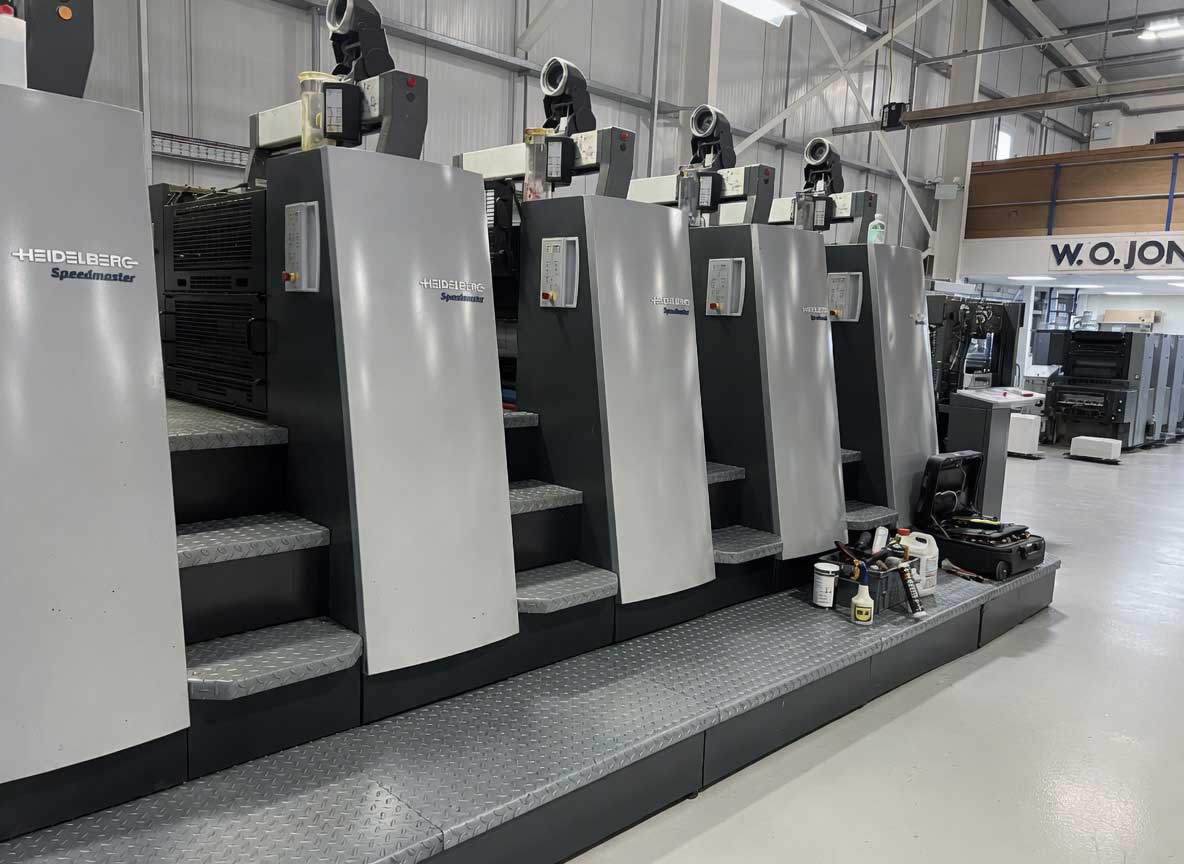
Walk into our works in Llangefni and you'll find something different. Alongside the digital presses, two multi-colour Heidelberg litho presses. Big, precise, meant for real volume, and the machines the whole shop floor is built around.
Heidelberg presses have been in use here for longer than most of the current team have been employed. Every few years, we get asked (usually kindly) whether we've thought about replacing them with something newer or smaller. The answer has always been the same. We haven't, and here's why it still matters to the customer.
What a Heidelberg press actually is
A Heidelberg is a multi-colour offset lithographic press, built in Germany, engineered to a standard that's genuinely rare in the industry. Ours prints four colours at a time (cyan, magenta, yellow and black, the CMYK that all full-colour print is built from), on sheets up to B1 or larger. Once the plates are made and the press is up to colour, it runs thousands of sheets an hour with astonishing consistency.
Litho printing is different from digital in one important respect. Instead of the ink being sprayed or fused onto the paper on a page-by-page basis, litho transfers the image from a metal plate, to a rubber blanket, to the sheet. That extra transfer step is where the quality comes from. It gives litho its cleaner tone, its sharper detail, and its remarkable colour consistency across a run.
Why we've stayed with litho at scale
For any job over roughly 1,000 copies, the maths of litho starts to work in the customer's favour. The setup cost (making plates, bringing the press up to colour) is the same whether you print one sheet or fifty thousand. So the per-copy cost drops sharply as the run size grows.
For a 5,000-copy brochure, a 10,000-copy leaflet run, an annual report going out across a national workforce, or a direct mail campaign at scale, litho is significantly cheaper per unit than digital. And the quality gap is visible in the hand.
That's the customer-facing case. Behind it, there's a professional case too. Litho at this quality level requires operators who know the presses intimately, and paper handling capabilities that come from years of doing this work. Neither is easy to buy off the shelf.
What you can actually see in the print
Put a good litho brochure next to a digital-printed equivalent and the differences are subtle but real:
- Cleaner solids. A block of colour on a litho sheet is more even, with less speckling under close inspection.
- Sharper text at small sizes. Down at 6 to 8pt, litho holds detail that digital tends to soften.
- Colour consistency across the run. The five-thousandth sheet looks identical to the first. On digital, drift over a long run is measurable, and on very colour-critical work it shows.
- Pantone matching. Litho can hold a Pantone colour with real precision using specific ink mixtures. Digital can get close using calibrated CMYK, but for brands with strict colour standards, litho remains the answer.
None of these differences are massive on their own. Together, they're the difference between a piece of print that reads as considered and one that reads as functional.
Why we run more than one press
Running two multi-colour Heidelbergs, rather than a single press, gives us a few things smaller shops can't match.
Two presses mean we can run a big job on one while continuing to serve regular short-notice work on the other. It means colour-critical jobs and paper-critical jobs can each go on the machine best suited to them. And it means the shop is less exposed to any single point of failure. If one press needs an unscheduled service, work still flows.
None of this is visible on a quote. It shows up in reliability. The kind of reliability that means when a customer needs 5,000 corporate brochures on the desk by Friday, we say yes without having to check.
The people who run them
A Heidelberg press does not run itself. It responds to a skilled operator who understands paper, ink chemistry, the way each stock takes colour, and the small adjustments that make the difference between a proof and a finished job.
Several members of our press team have been at the works for twenty years or more. They know the machines the way a good driver knows a car. When something drifts, they feel it before the sheet count reflects it. That's not romantic, it's practical. The operator's eye is a quality control step that no digital sensor has yet replicated in a print context.
Why it matters to the customer
The short version: for larger runs and colour-critical work, a Heidelberg litho press produces demonstrably better print at a demonstrably lower per-unit cost than the alternatives. That's not marketing, it's the physics of how the presses work.
The longer version is that when you choose a printer, you're not just choosing a machine, you're choosing the whole operation behind it. Presses like these are expensive to buy and expensive to run. They're maintained by a small industry of specialists across Europe. The printers who still run them do so because their customers demand a quality of finish that only litho can deliver, and because the maths at scale still works.
If you're printing a few hundred copies of a leaflet, digital is the right answer and we'll steer you there. If you're printing thousands of a brochure, a corporate report, a direct mail campaign, a member magazine, or an event programme, our Heidelbergs will do a better job than almost anything else you could send it to.
Common questions
What's the smallest run you'd put on a Heidelberg press?
In practice, around 1,000 to 3,000 copies is where litho starts to make economic sense against digital. Below that, the setup cost eats the per-copy saving. We'll always quote both options if you're near the crossover point, so you can see the numbers before deciding.
Can litho match a specific brand colour?
Yes, and this is one of the areas where litho really shines. We can mix specific Pantone inks to match a brand colour precisely and hold that match consistently across the full print run. For corporate work with tight colour standards, this is a genuine advantage over digital.
How fast is litho compared to digital?
Setup takes longer, print is much faster. Bringing a litho press up to colour and running the first good sheets can take an hour or two. Once running, the press produces thousands of sheets an hour with remarkable consistency. For any job of a few thousand copies or more, litho finishes well ahead of digital in total elapsed time.
Are there jobs where digital is still the better choice?
Absolutely. Short runs, personalised or variable data print, quick-turn tests, and last-minute jobs all suit our digital press better. The right question is never "litho or digital" in the abstract, it's "which suits this job". We'll always tell you honestly.
Will you still be running Heidelberg presses in five years?
Yes. There's no substitute on the horizon for the quality and economics of litho at scale, and our current presses have plenty of life left in them. If the industry ever produces something that does the job better, we'll take a look, but nothing on the market today comes close.
Talking through a print job
If you're planning a job that might benefit from litho, whether it's a corporate brochure, an annual report, a mailer at scale, a member magazine, or a large stationery print, we'd be glad to talk it through. We'll quote both litho and digital where the run size makes it a genuine choice, so you can see the difference before deciding.
Get in touch, or have a look at what litho at our works covers. There's a full list of what we do under one roof too, if the print is part of a wider project.