
How a brochure gets made: a job from quote to delivery at W. O. Jones
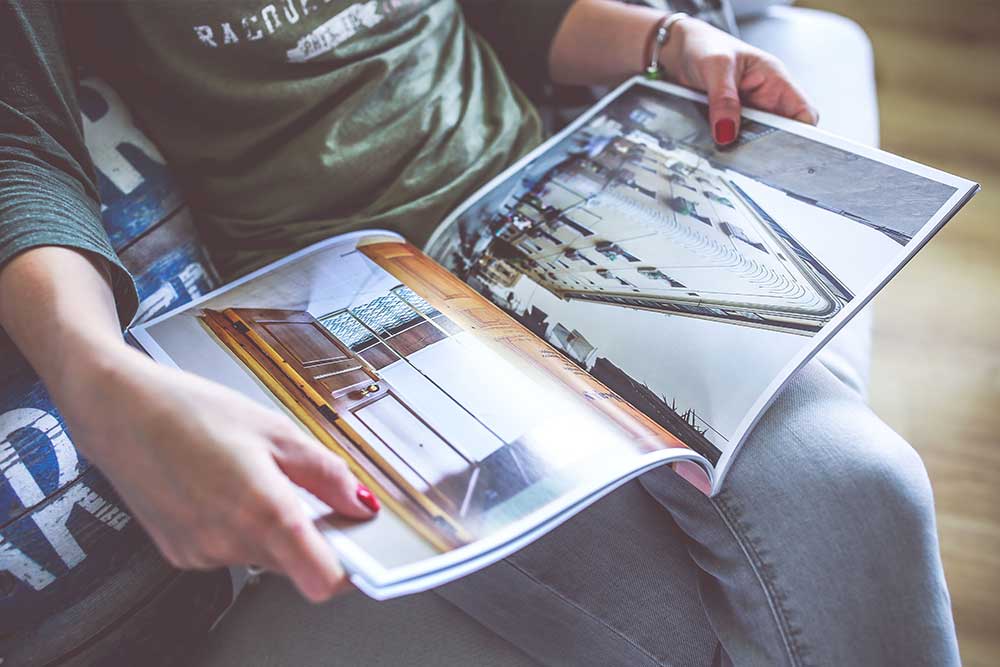
Most customers don't see what happens after they sign off on a brochure design. They see the start (the conversation, the quote, the artwork approval) and they see the end (a box of finished brochures on the doorstep). Everything in between is the bit that earns the price tag, and it's the bit we never explain because customers rarely ask.
So this is the full journey of a single brochure job at W. O. Jones, from the first phone call to the moment the boxes leave Llangefni. We've used a typical brochure run as the example: 5,000 copies, 24 pages, saddle-stitched, on a silk-coated stock with a matt-laminated cover. The kind of brochure a North Wales business might order to introduce a new service or refresh their corporate materials.
1. The first conversation
It usually starts with a phone call, an email, or somebody walking through the door at our works on the Llangefni Industrial Estate. The first thing we want to know isn't paper or finish or quantity. It's purpose. What's the brochure for? Who's going to read it? When does it need to be in their hands?
The reason we ask in that order is that everything technical follows from the answers. A high-end product brochure to be left in a showroom is a different beast from a fundraising appeal to be posted out. A 24-page corporate brochure to be handed out at a trade show needs different paper from a 4-page leaflet to be inserted into a magazine.
We'll also ask what the budget is, if you've got a number in mind. We'd rather be told up front and design the print to fit, than spend an hour designing the perfect specification and then have to rework it down.
2. The quote
Once we know what the brochure is for and roughly what it needs to be, we quote. Brochure quotes typically include four things:
- The paper for the inside pages (weight, finish, coated or uncoated)
- The paper for the cover (often heavier, sometimes different)
- The print run (number of copies)
- The finishing (binding type, lamination, any special techniques)
For a 5,000-copy brochure, the maths usually points to litho. The setup cost is the same whether you print one or fifty thousand, so the per-unit cost drops sharply with volume. For runs under a thousand or so, we'd usually steer you to digital instead. The crossover sits somewhere between 1,000 and 3,000 copies; for our example brochure, litho is the answer.
We always quote both options if you're near the crossover, so you can see the actual numbers rather than take our word for it.
3. The artwork stage
Artwork comes to us one of two ways. Some customers have a designer or agency and send us print-ready PDFs. Others ask us to design the brochure from scratch, which our in-house design team handles regularly.
Either way, the artwork stage is where most of the errors get caught. We check:
- Bleed. The small area beyond the trim line where the design needs to extend, so there's no white edge when the paper is cut.
- Image resolution. Too low and the print will look soft; we'll flag anything under 300dpi.
- Colour mode. Print uses CMYK rather than the RGB of digital screens, and converting between them can shift the appearance of certain colours.
- Fonts. Embedded in the PDF or supplied as outlines, so we get exactly what the designer intended.
If anything needs fixing, we'll flag it before plates are made. Once we've made plates, fixes are expensive. Before, they're routine.
4. Pre-press
Once the artwork is signed off, the file moves to pre-press. This is the bit nobody outside the trade really sees, and it's where a lot of the quality is set.
The file is imposed: the pages are arranged across large sheets in the right order to fold down to a finished brochure. A 24-page brochure isn't printed on 24 separate sheets; it's printed on a much smaller number of large sheets that fold into sections of 8, 16 or 32 pages each.
From there, we use a computer-to-plate (CTP) system to make the actual printing plates: one per colour, four for a standard CMYK job. We've used CTP for years; it gives sharper plates than older film-based systems, with no chemical waste from the film stage.
5. The press
The plates go onto the press. We run industry-leading multi-colour Heidelberg presses for our litho work. Once they're set up, they run at speed and produce highly consistent colour from the first sheet to the last.
The first hundred or so sheets are wasted as the press reaches colour stability. After that, the press runs the job, with an operator checking sheets at intervals against the approved proof. If the colour drifts, the operator adjusts the inking. If a problem develops, the press stops.
For our 5,000-copy example, the press time itself is fairly short. The setup takes longer than the run. That's the economic logic of litho: front-loaded effort, fast per-copy after that.
6. Finishing
The printed sheets come off the press flat. To become a brochure, they need to be folded, gathered into the right order, bound, and trimmed to size. The bind type drives the sequence:
- Saddle stitching (wire staples through the spine) is the most economical bind for brochures of 8 to 64 pages. Quick, neat, sits flat when opened.
- Perfect binding (a glued spine, like a paperback) suits 32 pages and up, and gives a more substantial feel.
- Wiro binding uses a metal coil. Common for instruction manuals and anything that needs to lie completely flat.
All of these we handle in-house at our Llangefni works. After binding, the brochure gets laminated (silk, matt or soft-touch) if the cover is meant to be more durable or to feel more premium. For our example brochure (5,000 copies, saddle-stitched, matt lamination), the finishing line takes around a day.
7. Quality check and packing
Before the brochures get boxed, the finishing team checks each pallet against the approved proof. They're looking for things like:
- Consistent trim across the run
- Lamination has bonded properly (no bubbling or peeling)
- Binding is square and tight
- Colour matches the proof from first sheet to last
Pieces that don't pass are pulled and reprinted if needed. The rest get boxed in groups of 50 or 100, depending on size and weight, and stacked on pallets ready for delivery.
8. Delivery
For most North Wales customers, we deliver the boxes ourselves. For longer journeys, we use a courier we've worked with for years. Either way, the brochures arrive in clearly labelled boxes, ready to use.
Total time from artwork sign-off to delivery for our example brochure: typically eight to ten working days. Faster is possible (we've turned brochures around in five working days when the timeline demanded it), but it leaves less margin for catching errors at the proof stage.
The people behind the job
A brochure job touches more hands at W. O. Jones than most customers realise. A typical 5,000-copy brochure run involves an account contact (the person on the phone), a designer (if we're handling artwork), a pre-press operator (preparing the file and plates), a press operator (running the litho press), one or more finishers (binding and laminating), a packer (boxing and labelling), and a driver (if we're delivering).
Most of them know each other's work. Several have been at the works for twenty years or more. That continuity is one of the quietly important things about a brochure run going smoothly: when somebody flags a question at any stage, they know who needs to answer it.
Questions we get asked
How long does a brochure take from quote to delivery?
For a typical saddle-stitched brochure of a few thousand copies, eight to ten working days from artwork sign-off to delivery is normal. The artwork and proofing stage usually takes another week or two on top of that, depending on how many rounds of changes are needed. Faster is possible. We've turned brochure jobs around in five working days when the deadline demands it, but the shorter the timeline, the less margin for catching errors at the proof stage.
Can I see the brochure before it goes to print?
Yes, always. We supply a soft-copy PDF proof first, which you sign off in writing. For larger runs or anything with critical colour matching, we'll also supply a printed proof on the actual stock so you can see how the ink and the paper behave together. Brochure proofs are not where you save money: catching an error at the proof stage costs nothing, catching it after printing means a reprint.
What's the most common mistake at the artwork stage?
Wrong or out-of-date contact details. A brochure full of beautiful design and an old phone number is a familiar sight. After contact details, the next most common issue is missing bleed on the artwork (no allowance for the trim), followed by low-resolution images. All three are easy to catch if the brochure is properly proofed before the press is set up. All three are expensive to fix after.
Can I make changes after I've approved the proof?
Until plates are made, yes. Once plates are made, changes mean re-making the plates, which adds cost and time. We make this very clear at the proof stage: signing off the proof is the point at which the artwork is locked. We'd rather you took a few extra days to be sure than rushed through and then needed to reprint.
How are brochures delivered?
For most North Wales customers, we deliver ourselves, often on the same vehicles that pick up paper or other materials. For longer journeys we use a courier we've worked with for years. Brochures arrive in clearly labelled boxes, packed in counts of 50 or 100 depending on size and weight, with a delivery note showing the count for your records.
Thinking about a brochure?
If you've got a brochure project on the horizon, whether it's a corporate brochure for a service business, an annual report, a sales catalogue, a fundraising appeal, a member communication for a club or charity, or a product brochure for retail or trade, we'd be glad to scope it with you. We'll quote the full job (paper, print, finishing, delivery) so you can see the economics in one place. No upsell, no agenda.
Get in touch, or have a look at our brochure printing page if you'd like to see what we mean. There's a full list of what we do under one roof too, if a brochure is part of a wider project.