
Choosing a commercial printer in North Wales: what really matters
We've been running W. O. Jones out of Llangefni since 1904, so we've spent rather a long time watching how businesses go about choosing a commercial printer. Some choose well. Some don't. After 120-odd years of helping customers make those decisions, and as the only commercial printer of any real scale left in North Wales, we've developed a view on what makes a print supplier worth using and what makes one worth avoiding.
This is that view, written as if we were buying print rather than selling it. It isn't a list of the best printers in the area. It's a guide to recognising a good one when you see one. The fact that we tick most of these boxes ourselves is, we hope, helpful rather than a coincidence.
Start with the kit they actually run
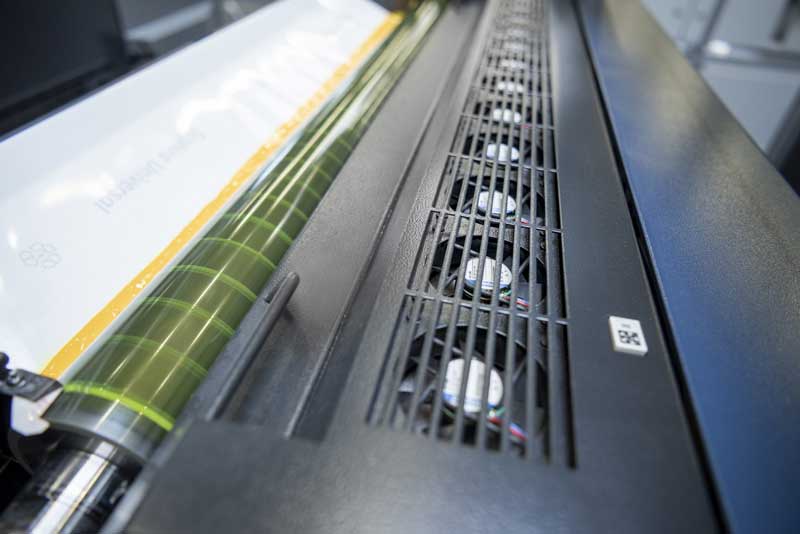
Print quality comes down to the presses, the people, and the paper, in that order. The single most telling thing about a commercial printer is what they have in the production room. If a printer is doing serious litho printing in any volume, they'll be running multi-colour presses from a recognised manufacturer (Heidelberg and Komori dominate this end of the market). For digital printing, the same applies to the digital presses (HP Indigo, Konica Minolta and Xerox are the workhorses).
You don't need to memorise model names. You just need to ask: what do you run, and what's it best at? A printer who can't answer that clearly, or who hides behind jargon, is one to be wary of. Honest printers love their kit. We run industry-leading multi-colour Heidelberg presses ourselves, alongside our digital kit, because those are the right machines for the work we do. We're the only commercial printer in North Wales now running presses at this scale, which is part of the reason a fair number of the smaller print shops in the region quietly send their bigger jobs our way. Ask us about the presses sometime, we'll happily walk you through them.
Look at what they can do under one roof
The difference between a good print job and a great one is almost always in the print finishing: lamination, die cutting, binding, perforating and similar techniques. A printer that can do all of this in-house controls the quality and the timeline. A printer that sends your job out for finishing introduces another link in the chain (and sometimes another margin) and loses control over how it comes back.
This matters more than it sounds. If something goes wrong with a foil block on Tuesday and the finisher is in Birmingham, your Friday deadline is in trouble. If the same thing happens with an in-house team, it's fixed the same day. Our 10,000 square foot unit on the Llangefni Industrial Estate handles pre-press, litho, digital, and every finish we offer, all under one roof, all with people we know by name.
That's how brochure printing, booklet printing, business stationery, leaflet printing, signage and large format printing all get made by the same hands, on kit that's properly looked after, in a building where someone can answer a question without picking up the phone. We call it a genuine one-stop solution. It's not a marketing line, it's how we run the place.
Pay attention to how they talk to you
Printers come in two flavours: those who explain things and those who hide behind technical language. The good ones know they're not just selling print, they're selling reassurance. You should be able to ask any question (about paper weight, ink coverage, finishes, why a quote is what it is) and get a clear answer in plain English, with no eye-rolling.
We've had it on our homepage for years: we promise not to blind you with technical jargon. We mean it. A printer who can't, or won't, explain things plainly is either inexperienced or hiding something. A printer who treats your project as worth understanding, no matter how large or small, is one who's going to look after the work.
Ask about turnaround, properly
Every printer's website says "fast turnaround". That phrase is meaningless on its own. What matters is the difference between a standard turnaround and a rushed one, and whether the printer is honest when something's tight. The right question to ask is not "how fast can you do this?" but "given the finishes I need, what's a realistic timeline?"
A printer who promises everything by Friday is a printer who's going to disappoint somebody on Friday. A printer who says, "we can do it, but it'll cost more and we'll need final artwork by Tuesday" is one who'll deliver. Our policy is to tell you the truth about timing before you commit, even when the truth is inconvenient. Honesty about deadlines is one of the most useful things you can buy from a print supplier, and it usually costs nothing extra.
Read reviews like a print buyer would
Online reviews are a mixed bag because the people most likely to leave one are the ones who had a problem. Look for printers with a healthy number of recent reviews from named businesses and individuals, especially the ones who sound like you: a small business with stationery to order, a charity with an annual report, a marketing manager with a brochure deadline. Twenty five-star reviews from people in your part of the world tell you more than a hundred reviews from across the country.
Pay particular attention to what reviewers say about service, not just quality. "The print quality was great" is good. "They sorted out an artwork problem the day before I needed it" is gold.
We'll be honest, we're rather proud of our own Google reviews. A perfect 5.0 from 191 customers! Every single one of them five stars. We don't know of another commercial printer in the country with a record like that, and we don't take it for granted. Have a read before you commit.
Heritage and longevity tell a story
A printer who's been running for forty or fifty or a hundred years has lasted because they're consistently good. Print is a tough trade. Cheap online competitors and shifting customer behaviour mean only the printers who really know what they're doing tend to survive at any real scale. Longevity isn't a guarantee of quality, but in this business, it's a strong signal.
It also tells you something about how a printer treats people. A printer with a forty-year client base has spent forty years not falling out with them. We've been at it for one hundred and twenty, since W. O. Jones himself set up the press on the old foundry site in the centre of Llangefni in 1904, around the time of the Methodist revival. The business passed to his son Hefin, then to Hefin's son Martin and his wife Pat, and is now run by their son Marcus. Four generations of people whose name is on the door, which tends to focus the mind on doing the work properly.
Five questions to ask a commercial printer before you decide
If you're sitting down with a printer for the first time, a few questions worth having ready:
- What presses do you run, and what are they best suited to?
- Do you handle finishing in-house, or do you send it out?
- What's a realistic turnaround given my finishes and deadline?
- Can I see a sample of something similar to what I'm asking for?
- Who would my main contact be once the job's underway?
The answers, and how they answer, will tell you most of what you need to know. You're welcome to ask us the same five questions. We'll happily answer all of them over a cup of tea at the works, or on the phone if Llangefni is a stretch.
Questions we get asked
What's the difference between litho and digital printing?
Litho printing uses metal plates to lay ink onto paper, so setup takes longer but the cost per copy drops sharply as the run gets bigger, and colour consistency is hard to beat. Digital printing prints straight from a file with no plates, which makes it faster and cheaper for short runs and lets you change data on every copy (useful for personalised mailings). For most jobs above a few hundred copies, litho is the better answer. We run both, and we'll tell you honestly which one suits your job.
How do I choose a commercial printer in North Wales?
Look at the kit they actually run, ask what they handle in-house, listen to how they explain things, check recent reviews from businesses that sound like yours, and weigh how long they've been doing it. The seven sections above go into each in detail. As things stand, we're the only commercial printer of any real scale still operating in North Wales, so the local field is narrower than it used to be.
Is a local printer better than an online print supplier?
For cheap, fast, commodity jobs (basic business cards, generic flyers), an online printer is hard to beat on headline price. For anything where quality, paper choice, print finishing, or a real conversation matters (brochure printing, booklet printing, annual reports, large format printing, packaging, specialist finishes), a local printer with proper commercial kit will almost always do better work, faster, with someone you can actually phone.
What should I ask before ordering brochures, booklets or leaflets?
Three things, in this order. What paper weight and finish suits the use case (your printer should help you decide, not just default to the cheapest stock). What's a realistic turnaround once finishing is factored in. And where the price breaks sit on the print run, because per-unit costs drop noticeably above certain quantities, and it sometimes pays to order a few more copies rather than a few less.
Can commercial printers handle finishing like foil, embossing or binding in-house?
Some can. Many of the smaller print shops in North Wales can't, which means they send finishing jobs out to a third party (sometimes to us). That adds time, another margin, and another link in the chain. We handle every finish we offer at our Llangefni works: foil blocking, embossing, die cutting, laminating, perforating, binding and the rest. It's part of why a fair number of regional print suppliers quietly send their bigger jobs our way.
Thinking about a project?
That's the case for choosing a printer the way we'd choose one ourselves. If you've got something on the horizon, whether it's a brochure or annual report, business stationery, booklet printing, a run of leaflets, signs and banners, large format graphics for an event, packaging, or a job that needs specialist finishing, we'd be glad to talk it through. No job's too small to deserve a proper conversation, and none's too big for our kit.
Give us a call or drop us a line, or have a look at the full list of what we do under one roof if you'd like to see what we mean. There's more of our story on the about page if you'd like a look at how we got here.